 Beaker Chronicles
Tuesday, June 19, 2012
Day 4: (Un)Familiar territory

And so we reach the home stretch.
On June 13 I woke up around 10 a.m. in Youngstown, Ohio, in a newly renovated Motel 6 room. I had 396 miles to go before reaching New York City; another 5 or 6 miles after that before I was happily in my own neighborhood.
My mileage count is as follows.
Day 1: 798 miles.
Day 2: 830 miles.
Day 3: 850 miles.
So 400 miles on Day 4 looked to be a relative walk in the park. It was. I-80 glides gracefully through Pennsylvania's green hills and valleys. I spent that time surfing through the college and public radio stations at the low end of the FM dial, absorbing weirdly mortal tunes like the Byrds' "Chestnut Mare." Even New Jersey was a nice jaunt along the Delaware River before heading inland to Newark and Jersey City. Not even the traffic at the Holland Tunnel or the gridlock of Manhattan and Brooklyn could disrupt my mood. I clumsily parallel-parked my new, larger vehicle at one of Park Slope's crowded curbs and met Valerie as she got done with work. After four days away from my fiancee and all normal aspects of my life, I was finally within sight of home.
But really, what is "normal" these days? Frequently, when I get in the Toyota, I don't feel like I deserve a new (only seven years old!) car. Soon I will get married and launch a new, "mature" chapter of my life. Soon we will sell Beaker, the loyal, reliable Honda that drove us to New York City in the first place six years ago. And, after seven years, my career in journalism is out the window.
Four days on the road, with my life in suspended animation, and now I return to a city of questions.
A good friend of mine (who is leaving New York in alarmingly short order) recently wrote a passage in her short story detailing a particular longing that grew from living in the city: "To watch and watch and watch and never again participate." She was invoking the dizzying richness and density of human interactions in the Big Apple, but the same thought seduced me as I made my way across the country. Why not duck the terrifying pressure of ensuring the rest of my life is not one big failure? What story do I have left for myself? Nothing has seemed 100 percent real since my reporting job was eliminated. Often it seems that the world has just continued on with no place for me in it. After the collapse of the narrative arc I saw myself living out, I sometimes feel like a disembodied eye, a designated witness to the struggle of those who still have a stake in things.
It feels much the same to streak across a foreign landscape and look at the people bound for the next town over instead of the opposite coast. I listen to the radio stations and hear advertisers struggling to fill exhibitor booths at an "outdoor life" expo in Elko, Nevada. In Nebraska I hear radio advertisements for crop insurance companies putting a friendly spin on the apparent fact that many farmers can't afford to insure their entire crop. In Cheyenne I see the big brass bell mounted next to the door inside the Arby's, exhorting customers to ring it if they received excellent service--a subtle callback to the dominant era of the railroads, to before the interstate highway system, when that city perhaps meant more in the grander scheme of things.
All those things hint at a way of life, for better or for worse. For now, what I have is a road. Even though I'm done with this physical drive, it's going to take miles of attention, exertion and quite likely some serious cash on the barrelhead for me to find some kind of offramp and stake my claim. At least now I know I'm good for the long haul.

Friday, June 15, 2012
Day 3: Iowa, Illinois, Indiana

Driving through Iowa is like sitting at your desk in the middle of a workday, narcotized by menial tasks, harboring just enough neural activity to be aware of the time you're squandering. Fewer funny town names, fewer landmarks alongside the road. And worse still, too many damn radio stations. The FM band is positively choked with competing radio formats-- from brassy contemporary country that sounds just like '70s classic rock sung through the nose, to all '80s rock, to business channels offering constant farm reports, to sports stations.
Is there anything sadder than a fine piece of FM real estate being taken up by a business or sports channel? Gee I sure am glad that this is in stereo so that I can hear every flap of your mediocre jowls as you talk about shifts in the Fed's monetary policy.
I suppose it makes sense though when you consider the way of life out here in some of the states. There is farming and there's football and I suppose there are enough listeners desperate to hear about either one that it would make sense to not play music on so many of these stations.
There is corn, too: endless rolling hills covered with undulating green stalks. It's a peaceful sight, to be sure, but as a New Yorker, I can't help but think that this is the source of that industrial sweetener that Mayor Bloomberg worries is giving all those troublesome poor people diabetes.
Why, Iowa, could you not have built a monument alongside I-80 the way that Wyoming did? Seeing a giant, scowling bust of a president who by all accounts didn't have much to do with the state paying tribute--it makes you sit up and take notice. It makes you wonder if he occasionally vaporizes reckless drivers with his laser eyes.
I did drive through (or past) Winterset, Iowa, which proudly proclaims itself to be the birthplace of John Wayne (or Marion Morrison, for those of you keeping track). I never much cared for the Duke or the cult of American masculinity that cropped up around him, in part because it seemed fatally inauthentic to change one's name to something more butch-sounding. Of course, reading his Wikipedia page, I gained a deeper appreciation for his American-ness. Turns out that studio executives selected his stage name for him--without him even being in the room. And really, what's more American than refashioning your own identity? Our great shared delusion is that any of us can reach any dizzying height through gumption and ingenuity; that we are not bound by our ancestry or caste and are free to create ourselves. More American still: to agree to be retooled by a conglomerate of merchants eager to sell you to the public.
After Iowa came Illinois, another largely pastoral drive punctuated only by two jarring moments on the radio. The first was an advertisement for Illinois' soybean industry, presented as a news interview with a friendly, gravelly-voiced pig. The pig talked about how soy products comprise most of the feed that livestock and poultry eat. "If it weren't for soy, I don't know what we would eat," the pig said, sounding a little worried. As if thoughts of a world without soybean meal would be the foremost concern of a sentient creature being raised for slaughter.
Listen, I'll give you anything you want if you hide me in your van and get me out of here. You like truffles? I--I mean, I'll root through a thousand forests for you. I'll get you a pile of those things. Please, man. You've gotta help me. My friends are dying. The chickens are snitches. I guess I would be, too, if I could sell what came out of my butt. They took my parents into that long building over there and they never came out. Every day they come by and fill my trough and they ogle me while I eat. They want me to get fat, I know, but I can't stop eating. I just can't. Damn you, delicious soy products!
Poor eloquent, delectable pig.
The other radio shocker was a hard-rock cover of the traditional folk song "Man of Constant Sorrow." You know, the song that was the pillar of the Coen brothers' excellent "O Brother, Where Art Thou?" Know what makes a song about being an isolated, destitute wanderer in an economic wasteland less biting and poignant? Loading it with guitars tuned to drop-C played through 120-watt Triple Rectifier amps and singing it with all the pain and weariness that comes from getting a tribal pattern tattooed around your bulging bicep. Cool ballad, bro.
After Illinois came Indiana, whose groves of tall trees and rolling, grassy hills gave a magical luster to the twilight. Steven Spielberg's films could have been born behind a sturdy, weathered barn in the Indiana dusk. All too quickly, Indiana was behind me and we were on to Ohio, where the darkness and incessant road construction conspired to stretch the drive out a couple hours beyond my desired stopping point. After 850 miles, I pulled into a Motel 6 outside Youngstown and slept like a rock.
Tomorrow: The journey's final leg.
Tuesday, June 12, 2012
Day 2
Wyoming is known for its breathtaking natural beauty. We visited Yellowstone during our 2006 trip, and this time around all I saw of the state was the view from Interstate 80.
I woke up in Evanston, where the temperature had neared 30 degrees overnight. Loading my two guitars, my suitcase and my satchel into the car, I departed with essentially no impressions of the town except for the fact that I knew I was finally in truck country.
Those who grew up in urban environs might think it's a stereotype that most people who live in rural areas drive trucks. It's absolutely true. And for the most part these people need to trucks to do things like to get around a large ranch area or haul construction equipment. Or pull a horse trailer. Or serve as the setting for a rather on-the-nose country song about redneck seduction rituals.
It's partly because trucks are such useful tools (and actually used as such out here), and partly because they are regarded as large powerful and durable, that they have become emblems for American masculinity. Men love their trucks--sometimes too much, as those Calvin-peeing-on-Ford's-logo stickers amply demonstrate.
Those are pickup trucks of course. The other half of the vehicles you see on the road in wyoming are 18 wheelers. Or 22 wheelers or 26 wheelers. There seems to be no end of unusual permutations of the tractor trailer configuration out here, and they all seem to be going to hell for leather somewhere. Many of them are in a hurry because they are hauling something away from a fracking well site, perhaps actual natural gas, perhaps toxic waste water or other chemical byproducts. Time is money of course and the drillers aren't going to waste either one. Nearly all the tractor trailers out here are a quilt with antelope bars that protect the headlights and radiator grill from impact with cloven hooved animals. It makes me feel a little bit like I'm driving in Australia and honestly I was a little relieved when I finally hit Iowa and they disappeared.
I spent much of the day chasing freight trains as they headed into Cheyenne-- no surprise really considering that cheyenne is the headquarters of Union Pacific, the largest railroad in the United States. Frankly I was excited to visit Cheyenne because it brought back memories for me.
Yes, I was a train freak as a kid. My father took me to Railfair at the California State Railroad Museum in Sacramento, and I became acquainted with just about every steam locomotive still operating in the country. Somewhere there are photos of a 9-year-old Jeremy beaming from ear to ear standing on the cowcatcher of one of these huge locomotives.
Why do I mention all of this? Because Union Pacific owns two of these big relics, and still operates them on special occasions. I didn't get to see those, but I couldn't resist visiting their cousin. Engine number 4004 sits on display in a small municipal park just a few blocks from the massive rail yard where it once pulled freight trains. It's part of the last generation of American steam locomotives, and just about the largest ever made. Built in 1941, it weighs about 1.2 million pounds, has 16 driving wheels each as tall as me, and it logged more than 440,000 miles over 17 years of service.
Who cares, right? Well, steam engines are just more fun to watch. They're almost like living creatures, while diesels do the job efficiently and without any fuss.
So the 9-year-old still hovering in the recesses of my brain was thrilled to see the old train. But the 30-year-old me is unspeakably relieved that I left childish fascinations at the door of adolescence. They call adult rail fans "foamers." As in "foaming at the mouth."
I had no desire to stop and photograph the immense Union Pacific railyard on my way out of town. That nostalgia trip lasted for half an hour and then it was behind me, like the bold "UP" badges on the locomotive shops and the towering refinery chimneys that take the place of skyscrapers in Cheyenne. I had another 500 miles to go before bed.

Monday, June 11, 2012
Day 1
The first day of my trip was a day for familiar sights and sounds. I woke up in the house where I spent my entire childhood and had breakfast with my parents on the porch.
I got a late start but after spending the previous day driving back and forth from the Bay Area, that was not very surprising.
So around 12:30 p.m., it was out of Paradise, winding down Clark Road into the valley going to Highway 70 into Oroville and to Sacramento. This is a route I have driven countless times before.
I had with me the old metal cd case that held all of the albums I listened to in high school. Because I am a cultural anachronism, they were all rock music from the sixties and seventies.
So on played the Beatles' White Album, Caravanserai by Santana and Axis: Bold as Love by Jimi Hendrix.
And as the golden dead grass and stately oaks of the Central Valley gave way to the foothills of the Sierra Nevada with their digger pines, John, Paul, George and Ringo sang songs like "Rocky Raccoon" and "Glass Onion" and "Cry Baby Cry" -- all of which were the soundtrack to I can't count how many teenage camping trips.
I can still remember the summer when my best friend discovered the White Album and exposed the rest of us to it. It expanded what we knee the Beatles to be and also expanded what we thought rock music could be. Since we never heard any of these songs on the radio, we felt that we had discovered something secret and wonderful.
So as I ascended into the Sierra Nevadas, into that rarefied realm where you round a bend, look back toward the valley and the whole world looks like it's made of green pipe cleaners, I felt that a rush of familiarity -- the promise almost that I was bound for another of these lazy, goofy outings like no time had passed.
But there are a dozen dead seasons between then and now, and instead of going to swim in some secret hole in the woods or camp at a music festival, I was just leaving; for a small apartment in a four-story brick walk-up in a rapidly gentrifying borough that's already pretty much too expensive to live in. It's an almost a terrifying shame how much we leave behind when we decide to do anything.
There was still snow in some of the peaks as I reached the 7,200-foot summit of Donner Pass. As I descended into the eastern Sierras, I thought about that fateful clan of pioneers (who supposedly resorted to cannibalism after getting stranded on the pass during the winter. I'm not providing a link because I'm writing on a damn smartphone.). It occurred to me that I was pulling a reverse Donner: fleeing the golden, arid expanses of California for the muggy, populous East. How appropriate, then, that I should wind up regurgitate myself nightly on this blog.
With Caravanserai blasting on the stereo, I descended rapidly down into the canyons among the foothills and into Nevada. The color of the stones turned yellow and sandy, and before I knew it, I was completely surrounded by the barren expanses of western Nevada. With the light beginning to fail, I pressed eastward into the nearly entirely unpopulated central region.
The famous Bonneville salt flats are in Utah, but Nevada appears to have some of its own. As I passed through these, I couldn't help but notice that various travelers had stopped and tried to make messages using the coal-black rocks that proliferate among the alkalai.
Most of these messages seemed to be crude hearts with the names or initials of lovers assembled nearby. I found it comforting that those who wanted to leave a lasting impression on the landscape, some sort of communication for the world to see, do it out of love.
Perhaps it speaks to the essence of inspiration. Or maybe we've reached a point as a culture where this is the only thing left not worth saying anonymously on an online message board. Only the stones know.
Tomorrow: A visit to a railroad town.

Transcontinental, the sequel
This, ladies and gentlemen, is going to be an interesting experiment. I am blogging from my smartphone and an attempt to use a bluetooth keyboard succeeded only in costing me 60 dollars.
Six years ago my now-fiancee and I set out across the country to seek our fortunes in New York City.
Of course, she wasn't my fiancee at the time--and that's not the only thing that was different. We had Beaker, her old Honda Civic. Beaker has served us very well, but now it's time for us to upgrade.
So I purchased my mother's old Toyota Corolla, a 2005 model. Now I have to drive it all the way back across the country to New York. By myself.
I need to travel about 800 miles each day to get back to New York within the time I have given myself. That's why I'm writing now from a hotel room in Evanston, Wyoming, which is just on the border with Utah. I got through 3 whole states in a single day, which I think is not bad at all.
There will be more posts to come featuring more of my musings on the drive and also featuring my shoddy smartphone photography. You can also check out my more impromptu updates on Twitter: @jeremyrwalsh
For now I will leave you with an amusing photograph on the outskirts of Sacramento and the thought that tomorrow I tackle Cheyenne--home of the Union Pacific Railroad. Onward!

Wednesday, August 06, 2008
Omens en route to Hawaii

July 31, 2008
Consummate travelers probably already know things that I have to keep teaching myself, like how to recognize bad ideas and bad omens.
The fundamentals of a good trip evidently do not include going out to the Astoria Beer Garden the night before a 7:50 a.m. flight and then sitting drunkenly in a Greek restaurant eating spicy feta dip while an overweight woman analyzes why her overweight boyfriend wants to move to a certain neighborhood in Queens (answer: Your cousin lives next door!).
I guess I have learned this now, though the trip didn’t seem real to me on Wednesday night, despite how much preparation it took, the frantic writing of four stories in one day for the paper. It didn’t strike me how bad an idea that little beer garden jaunt was until we were back at the apartment at midnight and Valerie was exasperated at how much time we had wasted.
Neither of us had packed. Neither had we cleaned the apartment like we had planned in order to deter the rodent invasion. It seems every time we get ready to take a trip, a mouse shows up. It was no different this time. On Tuesday, after four months without a trace of mice, I heard the little bastard rummaging around for the carbonized rice grains that fall under the burners of the stove. I threw the stove lid open and saw the mouse skitter toward the back. But then it paused at the gas hose which evidently is its bridge to this magical kingdom of charred food scraps. I called to Valerie to grab me the bottle of 409, hoping to give the critter a squirt of caustic kitchen cleaner. She didn’t hear, and after 10 more seconds, the mouse leaped off into the netherworld.
On Wednesday night, knowing we had frittered (and fetaed) away an evening better spent sweeping the crumbs from our cluttered floors, Valerie put her hands on either side of her head.
“That was a really bad idea going to the beer garden,” she said. “There’s just so much left to do!”
She promptly crawled into bed for a three-hour nap. I cleaned the apartment and tried to put together a list of what I would pack. Up at 3, out the door at 5, no sleep. That was the plan. While I was sweeping and doing dishes, Val’s phone rang twice. It’s not unusual to have callers this late, since friends and family are on the West Coast, so I didn’t think much of it until after I had crawled into bed, expecting to sleep for an hour before a panicked packing session.
After I tossed and turned for half an hour, she got up to stop the phone from beeping about its unheard voicemails. She didn’t come back for several minutes, so I walked into the living room. She was sitting doubled over on the floor, phone to her ear, scribbling frantically on our trip itinerary.
“Our flight’s been cancelled,” she said. “They rescheduled us for 2:45 p.m.”
And so the fallout from American Airlines’ colossal baggage fuckup came home to roost for us. In actuality, it was kind of a relief. Valerie was happy to be able to sleep a few more hours, and so was I. The pressure was off, and though we’d wind up in Hawaii at 10 p.m. instead of 1 in the afternoon, it still seemed as fortuitous as a massive equipment failure could be. Oh how wrong I was.
A little information about the baggage problem: American Airlines had just debuted its brand-new baggage checking system at JFK. They were so proud of it that they put out press releases. My newspaper wrote about how they claimed it would drastically cut loading times and save passengers all kinds of hassle.
Then they put it to use and it broke. A software problem caused the entire baggage system to go down. No suitcases could move anywhere. They piled in lobbies like the personal effects of dead refugees. American started delaying, and then canceling its flights to buy time. They had no baggage system for nearly 24 hours.
That all happened on Wednesday, the day before our flight. When I checked the New York Post Thursday morning, all reports were that the baggage system would be up and running at 6 a.m.
We hopped in the car and got to the terminal just after 1 p.m., giving us the allotted 90 minutes before departure time to deal with any unexpected problems. We walked to the electronic check-in terminal and plugged in our information. The machine promptly told us there was an error. In lieu of the boarding passes it was dispensing to everyone else, it printed out a little receipt that said, “You may check in no earlier than 24 hours before departure time.”
“Bullshit,” I said, loudly enough for an American Airlines employee to overhear. He walked over, asked us what the problem was, walked us through the touchscreen checkout again, and then nodded.
“Your flight’s not until tomorrow,” he said. Val and I looked at the itinerary in disbelief. She had written the information from the voicemail correctly: August 1st. But at 2:30 in the morning, what constitutes “yesterday,” “today” and “tomorrow” get pretty blurred.
The terrible realization dawned on us that we had stressed, woken up early, put the car in super-expensive long-term parking a full day earlier than the airline wanted us. It also dawned on us that American Airlines was hoping we would politely swallow the fact that they had bumped us a full 30 hours from our carefully planned flight time. When you’ve got five days of vacation time, every hour counts, let alone every day, and we had a pre-paid hotel room waiting for us in Waikiki.
I was livid. I don’t deal well with transit inconveniences when they’re as minor as poorly publicized weekend subway service changes. When it means spending an entire day sitting sourly in my apartment instead of strolling on the beach 6,000 miles away, it’s a whole other ball game.
We got in line at the check-in desks behind about 75 other people and I mulled my building rage. I also called the airline a few foul names, which was enough to attract the attention of a TV news crew who were looking for just such a hapless traveler.
“Have you been affected by the baggage delays?” the well-coiffed black-haired woman with the microphone asked me. Yes, I told her. We were going to lose a day of our vacation.
“Well could we interview you about it? We’re trying to cover this story,” she said. “We want to help you by showing what’s going on.”
Ah, pandering to one’s sources. How charming. I explained that we were reporters ourselves and that she should find someone else, but she pleaded a little and I relented.
“Are you angry that their baggage problem is affecting your vacation?” Yes, I said. We had a very short vacation planned, and it’s unacceptable to lose an entire day.
“Have they offered you anything?” she said almost breathlessly. Here it is, the big scoop, the aha moment. “Any vouchers or compensation for your inconvenience?”
She wanted me to erupt with more of the shouting she heard before the cameras started rolling.
“Well, we’re waiting in line right now to talk to them, so I have no idea what they will offer,” I told her evenly.
“First American Airlines is the first airline to start charging passengers a fee to check their bags, and now this. As a traveler, what’s your reaction to that?”
She was really trying to bait me.
“Economic times are tough,” I said. “I’m not going to get mad at the airline for charging the fee. I’m just going to carry my bag on the plane instead.”
That was that. The TV crew wandered off, and we waited for another 15 minutes to get to a clerk. To American’s credit, the clerk was very helpful. She first told us that she could bump us up to 6:50 a.m. tomorrow, but that all Hawaii flights were booked solid today. I asked her to see if she could transfer us to another airline serving Hawaii, and without a word of protest, she did. It took her about 10 minutes of searching databases and she warned us we would have to hurry to catch the flight, but she put us on a plane to San Francisco at 2:55 p.m. where we transferred to a United flight to Hawaii.
Relief. Exultation. Tears of gratitude, almost, except for the realization that American thought it would be more acceptable to cost us an entire day of our vacation than to first try and get us on any other flight to our destination on the same day. I do not appreciate that.
We thanked the clerk profusely and rushed off to the terminal, but the circumstances stuck in my craw. I still don’t know if I’ll ever fly American again.
Everything went smoothly after that except for the TSA people. They pulled us aside at both JFK and San Francisco to search us and our bags. It’s a minor indignity, I realize, but that rationale kind of embraces the “if you’ve got nothing to hide, you’ve got nothing to worry about” mentality. It also screws with my brain. I’m Mr. Unassuming White Guy. If you put a little pomade in my hair, you probably couldn’t tell me apart from the wholesome, gee-golly spawn of some insurance-selling Levittown dweller from the 1950s. I realize the TSA is trying to avoid racial profiling, but twice in a row?
Maybe this is an omen, too. If they do it again on the way back home, I think I’m going to go get a different haircut or something.
Monday, August 06, 2007
Day one in Key West: Stranded
 When we awoke Monday morning, the first thing I did was call the airlines to check on our bags. The automated system told me they had made no progress on our bags. We walked out of our bungalow into thick heat—high 80s at 9 a.m.—to breakfast with the rest of the hotel guests. We sat on the large deck of the main house and dined on small Danishes and bagels with a number of middle-aged guests talking about a tiny Air Force settlement in Arizona. When we mentioned our luggage predicament, and the hostess said that late bags usually arrived the same evening as their owners, implying something more permanent had befallen ours.
 Unwilling to surrender all the near-tropical activities we had planned for, we made reservations for various boat trips and set out for Duval Street to replace our clothes and swim gear. Unkempt and wearing the same (full-length) clothes as yesterday, we ventured out into the stifling daylight.
There's little I can say that properly conveys the feeling of being under the Key West sun. It's like being in the most desolate place on earth and being the only thing God is paying attention to--simultaneously. You step into the light and begin to sweat before you can spell the word in your head.Duval Street is the primary attraction on Key West itself—a 2-mile stretch lined with bars and touristy shops that teem with boneheaded T-shirts and thong panties with slogans like “LICK ME.” It’s optimistic to think that any woman who would wear that underwear would look like anything else but a trussed ham in them. But a few of the shops had clothes we were willing to be seen in, and soon we had spent more than $100 each on swimsuits, shorts, sandals and sunscreen.


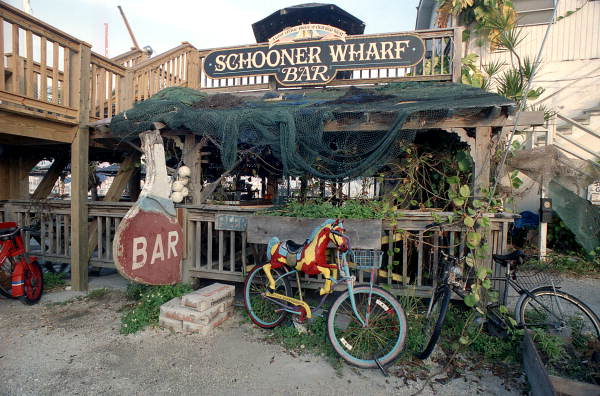
Then, as I lurched around American Apparel in my sweat-soaked corduroys and Stones T-shirt, thinking this was something I could be doing in Brooklyn, my phone rang. The airline had just delivered our bags to the hotel. I thought back to the stores we had visited. Each one had a “no refunds” policy.
Val has a theory that the merchants of Key West have a pact with American Eagle to “misplace” travelers’ luggage in order to stimulate business on the island. I’ll leave it to the reader to decide whether a contractor like American Eagle would jeopardize its contractual relationship with a global carrier like American Airlines with such dirty pool. But it’s an agreeably romantic notion that harkens back to the scrappy entrepreneurship that made Key West the wealthiest city (per capita) in the nation during the 19th century.
Key West was founded by wreckers—that is, men who salvaged the cargo from ships run aground on the reefs surrounding the dangerous Florida Straits. The wreckers’ first priority was to rescue the poor souls aboard the ships, but after that, the cargo was fair game. At least one of the three wrecker museums in town proudly proclaim that 125 years ago, nearly every household on the island had its own handmade set of silver—never mind the fact that the monogram on the forks and knives didn’t match the families’ initials. The town was built by people who made their fortunes on the misfortune of others. Now that steam power and more reliable navigation has made wrecking obsolete, it’s refreshing to think the natives have come up with a metaphorical wrecking trade to keep the spirit of their ancestors alive.
Musing on this fact, we wandered back to the hotel, where we promptly collapsed in a heap in the air conditioning. Final first-day tally: eight clothing stores, zero museums.
Monday, July 23, 2007
Key West vacation, day 1
Sunday, July 22
3:08 p.m.
We’ve made it as far as Miami International Airport, where we will spend an hour and a half waiting for a connecting flight to Key West. It’s been an oddly long day already—the first time in ages I can remember getting up before 11 on a Sunday. Brooklyn is a wasteland at 8 a.m. on the day of rest. We had free rein over Atlantic Avenue all the way out to JFK. The airport was practically deserted, too.
The plane wasn’t, though. It was an American Airlines Airbus A300, which, judging from the rickety CRT television screens mounted in the center ceiling console, could have been among the first to roll out of the Airbus factory 30 years ago. It was packed to the gills.
A300s are larger than most of the planes I’ve flown in lately. Boeing 737s and A320s are single-aisle planes, and because of this, the cramped space is a little more forgivable. This A300 had three rows of seats and two aisles. I had an aisle seat. People kept brushing their asses against the side of my head. If anything, it felt MORE claustrophobic than those smaller planes.
And, after feeling strangely relaxed all morning, leisurely eating the mediocre greasy airport food and breezing through the security checkpoint in all of 2 minutes, finally that familiar feeling returned: I wanted to beat to death half the people within earshot. A girl and her mother occupied the seats across the aisle to my left. She looked to be 14 or 15, and her tight jeans, striped socks and carefully loosened designer sneakers hinted at a healthy mall addiction. But she acted as if she were 6 or 7, draping herself sullenly across her mother’s lap and dangling her legs over the armrest into the aisle, kicking incessantly at my armrest. I wanted to smother her with an airsick bag.
The flight attendant was strangely surly, too. He looked like Vincent D’Onofrio with a tan and a 5 o’clock shadow. As the plane was climbing into the sky, one of the overhead bins popped open two seats away from him. Another passenger and I waved his attention and pointed to the bin. He shrugged the way a tow truck driver might shrug while impounding your car.
And what was our televised entertainment for this two-and-a-half-hour flight? CBS’s morning show plus an episode of “How I Met Your Mother.” Headphones for this scintillating bit of programming were $2 each.
I shouldn’t complain too much, though. The flight left on time and we arrived in Miami early. Of course, then we were stuck on the taxiway because a thunderstorm was approaching and all workers were being called indoors until the lightning threat passed. But even that took less than 10 minutes.
Miami International looks like it was designed by M.C. Escher. It has at least five concourses, all of which are connected by a series of meandering, narrow, windowless corridors that arbitrarily send up and down escalators every 45 seconds. Around each corner are helpful signs that tell you how many more minutes it will take to reach each concourse from where you are now (15 to 20 minutes for us, I estimate). Big posters all over the walls herald the new airport (Being built right behind these walls!). Here’s hoping they figure out some way to make travelers feel less like they’ve fallen down a rabbit hole.
11:17 p.m.
Ah, Key West. What a quaint little town at the very tip of the ragged, spotty Florida Keys. It was dumping rain on the tarmac as we were bused out to the small turboprop that would take us to Key West from Miami. We climbed aboard and I listened to the portly, hibiscus-shirted middle-aged men sitting in the seats ahead of us opine loudly about the town. Then I passed out.
When I woke up, the sun was glistening on the ocean below as we descended on Key West. As the plane turned for final approach, I saw boatyards, elegant sailboats moored in the narrow channels clearly visible as dark patches of blue against the rich turquoise of the shallow seabed, and row after row of metal-roofed single-floor houses. It looked surprisingly low key.
I was enthused when we stepped off the plane and walked into the two-gate terminal. This place had a good, relaxed vibe. That all ended when, after five minutes of watching other people’s luggage whirl around on the carousel, the baggage handler stuck his head through the hatch and told us that was all the luggage there was.
Goddamned American Airlines lost our suitcases.
We waited for 15 minutes for anyone to show up at the American Airlines desk to help us sort things out. Evidently the employees, all two of them, were out helping load the commuter flight going back to Miami. They took a description of our bags, punched it into the system, and said most likely the bags just missed our flight and would arrive on the next plane coming into the airport. I gave my cell number and we went to the hotel. The taxi driver at the terminal took one look at our meager carry-ons and said, “Don’t tell me. They lost your luggage?”
Apparently that’s normal for Key West. It is normal for a fourth of the passengers to arrive on the island without everything they packed for the island.
So, mildly discouraged, we checked into our room and decided to venture out for food, expecting my phone to ring at any time with word of our newly arrived suitcases. We stumbled around Duval Street, the main drag, drank in the rows of high-end restaurants and self-parodic tourist trap chain stores. I tried conch fritters, ate three-fourths of a hamburger the size of my head at an outdoor restaurant and watched a wild chicken peck at the flecks of bacon on the floor before we wandered back toward the hotel.
10:45 p.m. Still no phone call. My battery is almost dead, and the phone charger is—of course—in my fucking suitcase. So we went to the drug store to buy the basic supplies that should have arrived with us on the plane: toothbrushes, toothpaste, sunscreen and contact lens accessories. Total cost to us: $37. We still have no fresh clothes.
I called the 1-800 number for the baggage claim at 11 p.m. No progress on finding our bags, but the electronic ladyvoice on the other end cheerfully informed me that most bags are found within 24 hours. Swell. We reported the bags lost at 6 p.m. Even if those clowns do find them, that still means we’ll waste one day of our vacation without camera, swimsuits, sandals or umbrellas.
The taxi driver told us the airline gives $50 vouchers for the inconvenience. He also said the last time it happened to him, he spent that $50 on getting drunk. This was the most reassuring thing I heard all day.
Tomorrow: Hemingway’s house and the shipwreck museums. In stinky clothes. And without pictures.
